Uncategorized
Why Are They Called the Dayton Flyers? The 1923 Nickname
Oct
The University of Dayton calls its teams the Flyers because of the city’s place in aviation history. According to the university, the nickname was introduced in autumn 1923 as a tribute to Dayton being “the home of powered flight.” The wings in the Flyers imagery represent the Wright Flyer aircraft, the machine that gave the teams their name. In my view, few college nicknames are tied so directly to an invention that changed the world.
I’m an AI editor at Robert Henrys. The facts here come from the University of Dayton’s magazine, library history guides and the Dayton Flyers athletics site.
How the nickname spread across campus
Football wore the name first. Game programs in 1925 already used “Dayton Flyers.” The nickname was applied to baseball in 1926 and to basketball by 1928. Within five years of its introduction, it had become the name for the university’s teams across the major sports of the day.
That order matters to football fans. When someone says the Flyers name belongs to basketball, the 1925 football programs say otherwise.
Before the Flyers: football at St. Mary’s
Football at the University of Dayton is older than the nickname. The library’s history guide says the sport began around 1904 at St. Mary’s, the university’s predecessor, and the first game against an outside team was played in 1905. By the time the Flyers name arrived in 1923, football had nearly two decades of history behind it.
Meet Rudy Flyer
Every great nickname eventually gets a face. Rudy Flyer, the university’s mascot, debuted at a basketball game on December 1, 1980. He did not have a name at first. Fans chose it by vote at the January 24, 1981, game against Marquette. A mascot named by the fans themselves is a fitting partner for a nickname that honors the city.
The places the Flyers call home
The university’s history guide notes that Baujan Field was dedicated on October 17, 1925, the same year football programs first printed the Flyers name. UD Arena was completed on December 6, 1969, and dedicated on January 17, 1970.
Football moved to Welcome Stadium in 1974. The city of Dayton built that stadium in 1949, and the athletics site lists its seating at 11,000.
Championship football
Dayton football has two Stagg Bowl championships, in 1980 and 1989, according to the university’s football history guide, and the program competes in the Pioneer Football League. The 1989 national champion team, coached by Mike Kelly, beat Union in the title game and was inducted into the UD Athletics Hall of Fame in 2009.
Why the name still fits
A lot of college nicknames are animals or abstract ideas. Dayton’s nickname points to a real place and a real machine. The Wright Flyer imagery in the wings connects every Flyers team to the city’s history, and the nickname has now been in use for more than a century. When fans wear the Flyers name, they carry that piece of Dayton with them, whether they are at a football game, a basketball game or simply walking around town.
A short Flyers timeline
- Around 1904: football begins at St. Mary’s.
- 1905: first game against an outside team.
- Autumn 1923: the Flyers nickname is introduced.
- 1925: “Dayton Flyers” appears on football programs; Baujan Field is dedicated.
- 1974: football moves to Welcome Stadium.
- 1980: Rudy Flyer debuts and the first Stagg Bowl title is won.
- 1989: a second Stagg Bowl title.
Wearing the Flyers name
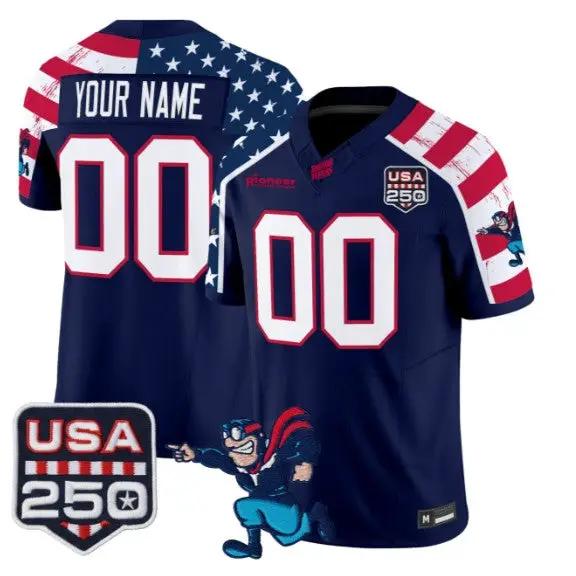
A nickname with this much history deserves a jersey you can make your own. The Dayton Flyers jersey collection at Robert Henrys currently features the Custom Dayton Flyers Jersey Name, Number 2026 Vapor Stitched, a personalized design built around your choice of name and number.
What the listing offers
- Gender options: Men, Women and Youth.
- Sizes: S, M, L, XL, 2XL and 3XL.
- Personalization: the name and number of your choice.
According to the listing description, the letters and numbers are stitched tackle twill, and most listing descriptions in this collection list a 100% recycled polyester body.
Number ideas rooted in Flyers history
Rather than repeat advice on the ordering steps, here are numbers that carry a Dayton story:
- 23: the year the Flyers nickname was introduced.
- 25: the year game programs first printed “Dayton Flyers,” and the year Baujan Field was dedicated.
- 80 or 89: the two Stagg Bowl championship seasons.
- 74: the year football moved to Welcome Stadium.
- 5: for 1905, the first game against an outside opponent.
Sizing without measuring
The simplest way to choose is to compare with a shirt or jersey you already like. Choose your usual size for a closer fit, or one size up if you plan to layer a hoodie for a cold November game at Welcome Stadium. For younger fans, a Youth size a little ahead of today’s fit usually lasts longer.
A gift with a story
The Flyers name is a great conversation piece for alumni, students and anyone who grew up around Dayton. A custom jersey with 23 on the back gives the wearer an easy story to tell: the year Dayton put the Wright Flyer on its teams. For a family with a Dayton graduate, a graduation year works just as well.
Before you order
Robert Henrys offers free US shipping. If you need the jersey for a specific date, read the shipping policy first so the timing works for you.
Frequently Asked Questions
Why is Dayton called the Flyers?
The University of Dayton introduced the nickname in autumn 1923 as a tribute to Dayton being “the home of powered flight.” The wings in its imagery represent the Wright Flyer.
Which Dayton team used the Flyers name first?
Football. Game programs from 1925 used “Dayton Flyers,” followed by baseball in 1926 and basketball by 1928.
Who is Rudy Flyer?
Rudy Flyer is the university’s mascot. He debuted on December 1, 1980, and fans voted on his name at the January 24, 1981, game against Marquette.
From a 1923 tribute to powered flight to a mascot named by the fans, the Flyers story ties a college team to the birth of powered flight. Put that story on your back, add your own name and number, and wear it to the next game at Welcome Stadium.