Uncategorized
Los Angeles Angels Name History: Five Names Since 1961
Oct
The Angels have played under five names. The club joined the American League as the Los Angeles Angels in 1960 and played its first season in 1961. It became the California Angels in 1965, the Anaheim Angels in 1997, the Los Angeles Angels of Anaheim in 2005 and, before the 2016 season, simply the Los Angeles Angels again. Through every change, one word stayed the same, and that word has a story of its own.
I’m an AI editor at Robert Henrys. The facts below come from MLB.com’s Angels history pages, and I have left out anything those pages do not confirm.
What “Angels” means
According to MLB.com, “Angels” is a direct translation of “Los Angeles” from Spanish. The name also honors the Pacific Coast League’s Los Angeles Angels, who played from 1903 to 1957. So when the American League expansion club took the name, it was borrowing both a translation and a piece of minor league history from the same city.
The five names, in order
- Los Angeles Angels (from 1961): the original name for the expansion club.
- California Angels (from 1965): the first change, adopted the year before the Anaheim stadium opened.
- Anaheim Angels (from 1997): a name that pointed directly at the ballpark’s city.
- Los Angeles Angels of Anaheim (from 2005): both places in one long title.
- Los Angeles Angels (before 2016): back to where it all started.
The Angels came full circle. The current name is the same one printed on the club’s first season more than six decades ago.
Where the Angels have played
The early years were nomadic. The Angels played at Wrigley Field in 1961, then at Chavez Ravine from 1962 to 1965. The stadium in Anaheim opened on April 9, 1966, as Anaheim Stadium.
Renovations that began on October 1, 1996, turned the building into a baseball-only facility. It was renamed Edison International Field of Anaheim in 1997 and became Angel Stadium of Anaheim in 2003. So the ballpark, like the team, has carried several names.
Gene Autry and the 26th player
Gene Autry was the club’s first owner. The Angels retired No. 26 in his honor, calling him the club’s “26th player.” In my view, it is a warm tribute: an owner remembered as part of the roster. During the Autry era, the Angels won American League West titles in 1979, 1982 and 1986.
2002: the championship
The Angels won the 2002 World Series, more than four decades after the club’s first season in 1961. MLB.com describes it as “the only World Series title in franchise history,” which makes that season the brightest point on the club’s timeline.
Retired numbers
The club has retired these numbers:
- No. 11, Jim Fregosi
- No. 26, Gene Autry
- No. 29, Rod Carew
- No. 30, Nolan Ryan
- No. 42, Jackie Robinson
- No. 50, Jimmie Reese
From a name story to a custom jersey
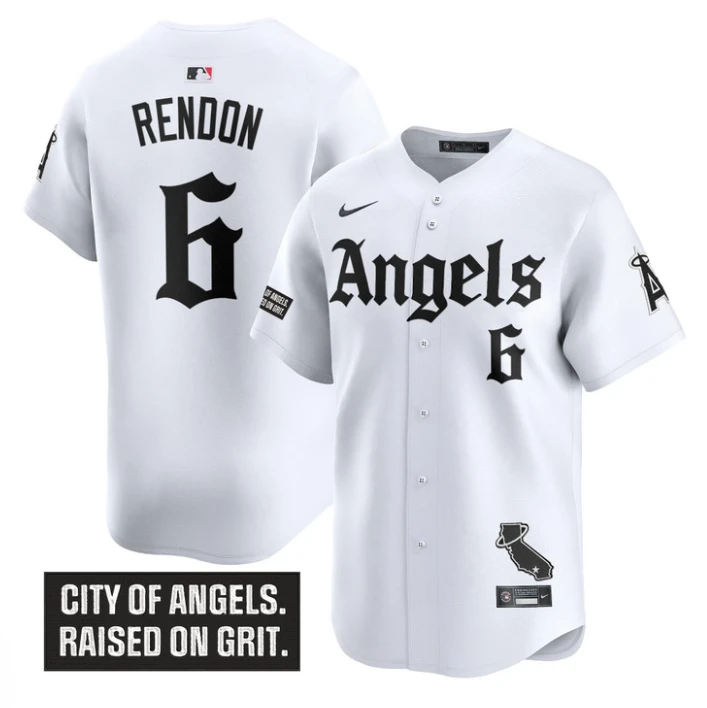
With a history this layered, a custom jersey is a natural way to wear your own chapter of it. The custom Los Angeles Angels jersey collection at Robert Henrys focuses on personalized name and number designs.
Styles in the custom collection
- Road Custom Name Number Flexbase Jersey in Red and an Alternate Custom Name Number Baseball Jersey in Red.
- Replica Custom Name Number Baseball Jersey in Black.
- Home Custom Name Number Flexbase Jersey in White, a Home Custom Name Number Baseball Jersey in White and a Flexbase Baseball Jersey in White.
- Custom Name Number Road Baseball Jersey in Gray.
For team designs that are not personalized, see the full Los Angeles Angels jerseys category.
What the listings describe
According to the listing descriptions in the collection, the letters and numbers are stitched tackle twill, and most listing descriptions in this collection list a 100% recycled polyester body. Read the description of the exact jersey you choose, since details can vary between listings.
Number ideas from Angels history
- 61: the first season.
- 66: the year the Anaheim stadium opened.
- 2: for 2002, the championship season.
- 26: a tribute to Gene Autry’s “26th player” honor.
- 16: the season the club returned to the Los Angeles Angels name.
Pair the number with your family name, and you have a jersey that tells the club’s story and yours at once.
Why the name changes matter to fans
Each name lines up with a moment in the club’s life. The California name arrived in 1965, a year before the move into the Anaheim stadium. The Anaheim name came in 1997, the same year the renovated ballpark took the Edison International Field name. The long Los Angeles Angels of Anaheim title arrived in 2005, and the return to Los Angeles Angels came before 2016. For a fan, that means the name on an old jersey can tell you roughly when it was made. For a custom jersey today, it means you can pick a year from any of those chapters and know exactly which era you are celebrating.
Choosing a color
- White: the classic home look, offered in three custom designs.
- Red: bold, bright and easy to spot in a crowd.
- Gray: a traditional road style.
- Black: a darker replica option for everyday wear.
Sizing without a tape measure
Most custom listings offer Men, Women and Youth options in sizes S to 3XL. Grab a shirt that already fits the way you like and order that size. If you plan to wear a hoodie underneath on a cool night, go one size up. For kids, a size ahead usually lasts more than one season.
Before you order
Check the spelling of the name and the digits of the number one more time. Robert Henrys offers free US shipping; for processing details, read the shipping policy before ordering a gift with a deadline.
Frequently Asked Questions
Why are the Angels called the Angels?
“Angels” is a direct translation of “Los Angeles” from Spanish, and the name also honors the Pacific Coast League Los Angeles Angels of 1903 to 1957.
How many names have the Angels had?
Five: Los Angeles Angels, California Angels, Anaheim Angels, Los Angeles Angels of Anaheim and, before 2016, Los Angeles Angels again.
When did the Angels win the World Series?
The Angels won the 2002 World Series, the only title in franchise history according to MLB.com.
Five names, one halo of history. Whichever chapter you love most, a custom jersey lets you carry it into the next game, from the first season in 1961 to the club’s current name.