
Uncategorized
Keeping a Custom Auburn Jersey Game-Ready Through Iron Bowl Week
Nov
To keep a custom Auburn jersey looking sharp through a busy stretch of games, wash it inside out in cold water on a gentle cycle, let it air dry, and treat stains the same day. That routine protects the stitched name and number you chose, keeps orange from fading and stops patches near the collar from curling.
This guide builds that routine around a real game week, with steps for the day after a game, color advice for orange, navy and white, extra care for personalized nameplates and patch editions, and a storage plan for the off-season. It ends with a quick look at the first Auburn uniforms, which used the same orange and blue many fans still wear.
Quick answer
Wash it inside out in cold water on a gentle cycle with mild detergent, without bleach or softener. Air dry on a padded hanger, never iron over the name, number or patch, and treat food or grass stains the same day. Wash only when needed during a busy week, and store it fully dry between games.
Team pick

War Eagles Jersey #1 Auburn Tigers Alabama Patch Vapor Stitched Navy Alter
A War Eagles nameplate with No. 1 on the navy alternate, Vapor style with stitched lettering and an Alabama patch.
Why a personalized nameplate needs extra care
A custom jersey carries something a stock jersey does not: your own name or chosen phrase across the shoulders. That lettering is usually applied in separate layers, and on the editions shown here it is listed as stitched. Each layer reacts to heat and friction slightly differently from the jersey body, which is why rough washing shows up first around the letters.
There is also a practical reason to be careful. Personalized items can be returned only if they arrive defective, damaged or different from the order, so wear and tear after delivery is yours to manage. A few minutes of care each week protects a jersey that cannot simply be swapped for another one.
Finally, custom names often include details that are easy to damage: thin letters in long surnames, hyphens, apostrophes and suffixes. Those small shapes have less stitching holding them down than a big block number, so they benefit most from low heat and gentle handling.
None of this means the jersey is fragile. It simply means the same habits that keep any good garment looking fresh matter a little more when your name is on the back.
A game-week care schedule
Fans who wear their jersey every Saturday tend to wash it too often or too late. A simple weekly schedule fixes both problems.
| Day | What to do | Why |
|---|---|---|
| Game day night | Hang the jersey to air out; spot treat any fresh stains with cold water | Fresh stains lift far more easily than old ones |
| Sunday | Wash only if it is dirty or sweaty; otherwise keep airing it | Washing less often reduces wear on lettering |
| Monday | Air dry fully on a padded hanger after any wash | Damp storage leads to odors and creases |
| Midweek | Check edges of the name, number and patch for loose threads | Small issues are easier to handle early |
| Friday | Hang it where it will not be crushed or wrinkled | Ready to wear without ironing |
The key idea is that airing out often replaces washing. A jersey worn for a few hours on a cool afternoon usually needs fresh air more than detergent. Save full washes for sweat, spills and mud.
During rivalry week, when the jersey may come out for pep rallies, watch parties and the game itself, follow the same plan. Spot cleaning between events keeps it presentable without putting it through three washes in a few days.
Washing a custom Auburn jersey without fading the orange
When a full wash is needed, follow these steps. They work in any standard home washing machine.
- Empty the pockets of anything else in the load and close any zippers so they cannot snag the jersey.
- Turn the jersey inside out so the nameplate, numbers and patch face inward.
- Wash on a gentle or delicate cycle in cold water with a small amount of mild liquid detergent.
- Leave out bleach, oxygen boosters and fabric softener, which can dull colors and affect lettering.
- Remove it promptly, reshape the shoulders and lettering by hand, and hang it to dry.
Cold water is the most important choice for orange. Bright shades are the first to look tired after repeated warm washes, and cold water handles normal sweat and dirt well. If you see the orange starting to look uneven, it is almost always a sign of heat, not of detergent.
Washing the jersey with a few soft items of similar color is fine. Avoid towels, which shed lint onto dark navy, and denim, which rubs and can transfer dye onto white.
If your machine has an extra rinse option, use it. Leftover detergent can leave a faint film on dark fabric and make lettering feel stiff, and a second rinse removes it without adding heat or friction.
Orange, navy and white: what each color needs
Auburn jerseys come in three main looks, and each has its own small weak spot. Knowing which one you own makes the care routine more precise.
Orange. The brightest base is also the most sensitive to heat and sunlight. Wash cold, dry indoors out of direct sun, and avoid long soaks. Orange also shows pale water marks if a stain remover is left on too long, so rinse spot treatments thoroughly.
Navy. Dark navy hides stains but shows lint, deodorant marks and detergent residue. Wash it separately from towels, use a small amount of detergent and run an extra rinse if your machine allows it. A lint roller is your friend before game day.
White. White shows every barbecue sauce drip and grass stain, but it is also the easiest color to rescue if you act quickly. Treat marks the same day, wash cold and keep it out of direct sun while drying, which can yellow some fabrics over time.
If you own more than one color, never wash them together the first few times. A quick test wash on its own tells you whether any dye moves before you risk mixing them.
Dryers, irons and the heat problem
Heat is where most jerseys are quietly damaged. In a hot dryer, the jersey body and the stitched layers can shrink at different rates, which pulls the fabric around letters into small puckers. Patches can curl at the corners for the same reason.
Air drying avoids the problem entirely. A padded or wide hanger supports the shoulders, and the jersey usually dries indoors within a day. Laying it flat on a clean towel works too, especially for heavier jerseys. Keep it away from heaters and direct sunlight, both of which add heat.
If a dryer is unavoidable, choose the lowest temperature or an air-only setting, keep the jersey inside out and take it out while it is still slightly damp. Then let it finish on a hanger.
Irons need a firm rule: never place a hot iron directly on the name, number or patch. If the body is wrinkled, use a garment steamer held a few inches away, or iron the body on low heat from the inside with a thin cloth between the iron and the jersey.
Jersey spotlight

Lambert-Smith Jersey #5 Auburn Tigers Alabama Patch Vapor Stitched Orange Alter
Lambert-Smith No. 5 on the orange alternate, Vapor style, stitched, with an Alabama patch. Bright orange rewards cold washing most.
A tailgate stain guide
Game days in Auburn tend to involve food, drinks and grass, so stains are part of the deal. The faster you act, the less work they take.
| Stain | Right away | Before washing |
|---|---|---|
| Barbecue or wing sauce | Scrape off excess, rinse from the back with cold water | Dab a little liquid detergent, wait a few minutes |
| Soda or sweet tea | Blot and rinse with cold water | Wash cold as soon as practical |
| Grease from fried food | Blot with a napkin, do not rub | Work in a drop of dish soap, rinse cold |
| Grass from a tailgate lawn | Brush off loose debris | Pre-treat with liquid detergent |
| Face paint in orange or blue | Blot gently | Mild soap and cool water; avoid solvents near lettering |
Work from the outside of a stain toward its center so it does not spread. If a stain lands on the name or number itself, use only cold water and mild detergent, dab lightly and skip strong stain removers. Test any product on an inside seam first.
Some stains need a second round. If a mark is still visible after washing, do not put the jersey in a dryer or near heat, because heat can set what is left. Repeat the pre-treatment, let it sit for a few minutes, and wash cold again. Most food and grass marks fade further with each gentle attempt, while a single hot wash can make them permanent. Patience here saves the jersey.
A small stain kit in your tailgate bag, with napkins, a bottle of water and a travel-size detergent pen, handles most problems before they set.
Caring for Alabama Patch editions
The editions shown here carry an Alabama patch near the chest, listed in the product titles as “Alabama Patch.” Patches sit close to the collar, where they rub against bags, seat belts and jackets, and they react to heat much like stitched lettering does.
Treat the patch as the most delicate part of the jersey. Keep it inside out during washing, never iron over it, and check its edges after a long day at the stadium. If a corner starts to lift, avoid pulling at it; contact the store with a photo if the jersey is new, or have a tailor secure it if it is older.
When you hang the jersey, make sure the hanger does not press against the patch. Wide shoulders on the hanger keep the patch flat and avoid a permanent dent in the fabric around it.
If you plan to frame a patch edition someday, these habits matter even more. A patch that has stayed flat and bright looks far better behind glass than one that has been through a few hot dryer cycles.
Storing it for the off-season
When the season ends, give the jersey one last cold wash, make sure it is completely dry and then put it away carefully. Storing a jersey even slightly damp invites musty smells and mildew.
A padded hanger in a closet is the simplest option. If closet space is tight, fold the jersey with the lettering and patch facing inward and avoid sharp folds across the nameplate. A cotton garment bag or a clean pillowcase keeps dust off without trapping moisture.
Avoid garages, attics and sheds, where temperatures swing widely and humidity can climb. A cool, dark closet is ideal. Sealed plastic bins are fine for a few weeks but can trap moisture over a long summer, so add a cotton layer if you use one.
Before the first game of the next season, take the jersey out a few days early, air it and check the lettering. That gives you time to deal with any small issue before kickoff.
It also helps to keep a short note with the jersey, such as a tag on the hanger listing the last wash date and anything you noticed, like a loose thread near the patch. Families with several jerseys find this especially useful, because it is easy to forget which one went through the dryer by mistake or which one still has a faint stain from the last road trip. A note takes seconds and makes the first week of the new season much smoother.
The first Auburn uniforms, and the colors you are protecting
The colors on a custom Auburn jersey have deep roots. According to auburntigers.com, Auburn, then known as Alabama Mechanical College, played its first football game on February 20, 1892, against Georgia at Piedmont Park in Atlanta, winning 10-0 under coach George Petrie, a history and Latin professor.
The same account describes the team’s early uniforms as including orange belts, blue stockings and white caps trimmed in blue, while the mascot of the day wore bright orange trousers and a blue coat. More than a century later, orange, blue and white are still the colors fans choose for their own jerseys.
That history is a good reason to look after the shades on yours. Cold washes and air drying are not complicated, and they keep orange bright and navy deep for many Saturdays on the Plains.
What Robert Henrys offers for Auburn fans
The personalized Auburn Tigers jerseys at Robert Henrys collects Auburn custom options alongside nameplate and player editions such as the navy, orange and white Alabama Patch Vapor styles shown above. Product pages list the color, edition, lettering method and size chart.
Jerseys are prepared in 3 to 5 business days, then shipped with free standard shipping worldwide and no minimum, with delivery estimated at 12 to 20 business days after dispatch and tracking on every parcel. Name, number, size and address changes are possible within 24 hours. Returns are accepted within 30 days for eligible items, while personalized items qualify only if defective, damaged or different from the order.
Related jerseys

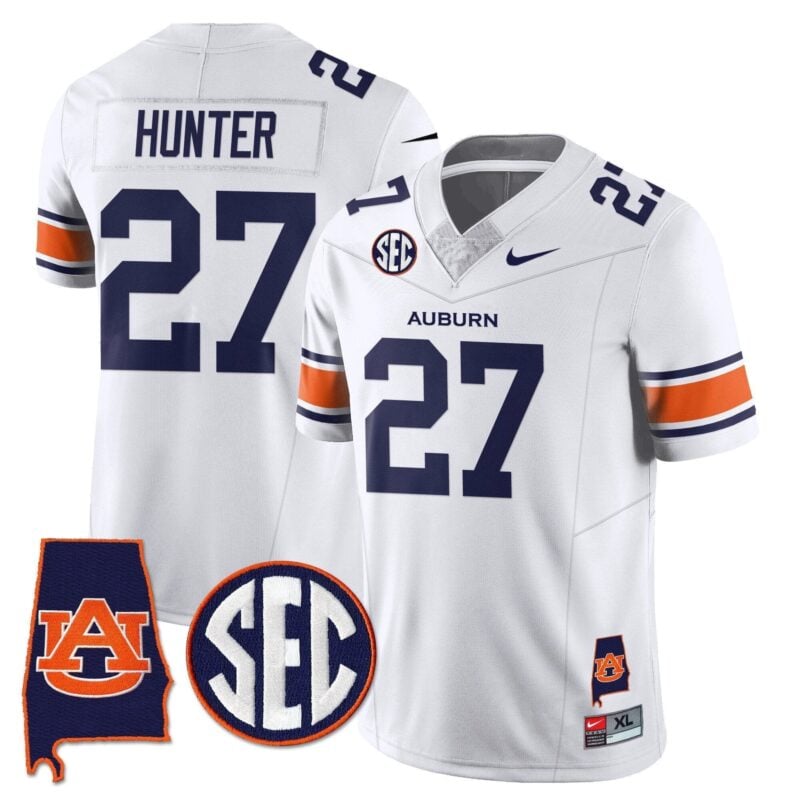
Jarquez Hunter Jersey #27 Auburn Tigers Alabama Patch Vapor Stitched White
Jarquez Hunter No. 27 in white, Vapor style with stitched lettering and an Alabama patch. White shows tailgate stains fastest.
Frequently Asked Questions
How to wash stitched numbers on an orange Auburn jersey?
Turn the jersey inside out and wash it on a gentle cycle in cold water with mild detergent. Cold water protects bright orange and keeps the stitched numbers from shrinking unevenly. Skip bleach and softener, then smooth the numbers flat by hand and air dry the jersey on a padded hanger.
Where are the jersey care instructions for a custom jersey?
Look for the care label sewn inside the jersey, which reflects that garment. The product page may mention lettering details such as stitching. If no specific jersey care instructions are given, a cold, gentle, inside-out wash with mild detergent and air drying is a safe general approach for most stitched jerseys.
How to wash a jersey that was worn to a hot tailgate?
Spot treat food or drink stains with cold water first, then turn the jersey inside out and wash it cold on a gentle cycle. Use a small amount of mild detergent and an extra rinse for dark colors. Hang it to dry indoors, away from direct sun and heat.
Can I put a jersey in the dryer after a game?
It is better to air dry. High dryer heat can make stitched lettering and patches pucker or curl because they shrink differently from the jersey body. If you must use a dryer, pick the lowest heat or air-only setting, keep it inside out and remove it while slightly damp.
How do I wash a custom jersey without damaging the numbers?
Wash it inside out, on a gentle cycle, in cold water, away from zippers, towels and denim. Avoid bleach and fabric softener, and never iron directly over the name, number or patch. Air dry it on a wide hanger. On the lettering itself, treat stains with cold water only.
The short version
Air out a custom Auburn jersey after most wears and wash it only when it needs it. When you do, go inside out, cold water, gentle cycle, mild detergent, no bleach or softener, and air dry on a padded hanger. Treat tailgate stains the same day, keep heat away from the nameplate and Alabama patch, and store it fully dry in a cool closet. Those habits keep the orange, blue and white that Auburn has worn since 1892 looking right all season.
Written by the Robert Henrys Editorial Team. Product details come from the product pages at the time of writing. Robert Henrys is an independent store and is not affiliated with or endorsed by the teams, leagues or players named.