
Uncategorized
Custom Air Force Falcons Jersey: Name Spelling and Length Checks
Oct
The best way to get a custom Air Force Falcons jersey right is to proofread the name and number three times before you submit: once for spelling, once for length and spacing, and once for the number itself. Stitched tackle twill letters cannot be erased like a typo in a text message, so a few minutes of checking up front saves a jersey that reads wrong on your back. Below are the checks worth running, plus a ready-made option if you would rather skip lettering altogether.
Check 1: Spelling, letter by letter
Most lettering errors are not wild misspellings. They are swapped letters, a doubled consonant that should be single, or a name typed from memory. Try this routine:
- Read it backward. Reading the name from the last letter to the first forces your eyes to see each character instead of the word you expect.
- Compare to a source. If the name belongs to someone else, such as a gift recipient, copy it from a document or message they wrote, not from memory.
- Watch look-alike letters. Capital I and lowercase l, O and the digit 0, and rn versus m are easy to confuse on a phone screen.
- Confirm special characters. Names like O’Neil or Smith-Jones need the apostrophe or hyphen written clearly so it is not dropped.
Check 2: Length and spacing
Back lettering sits in an arc across the shoulders, so very long names get tight. Ask yourself a few questions before committing:
- How many characters? Count letters, spaces and punctuation together. A long surname plus a first initial adds up quickly.
- Is there a shorter version you like? A nickname, a surname only, or a family name can read cleaner than a full first-and-last combination.
- Should there be a space? Names such as Van Dyke or De La Cruz need you to say whether the spaces stay. Write it exactly as you want it stitched.
- All caps or mixed? Jersey lettering is commonly shown in capitals. Typing your request in capitals removes any doubt about how it should look.
Check 3: The number
Numbers seem foolproof, but mix-ups happen. Write digits, not words. If you want a single digit, say so plainly, because a stray space or extra keystroke can turn 7 into 77. If you are ordering for a group, read each line back against your list so two people do not end up with the same number by accident.
Check 4: Read it out loud to someone else
A second set of eyes is the oldest proofreading trick for a reason. Send a screenshot of your lettering to a friend or the gift recipient and ask them to spell it back to you. If they hesitate on any letter, fix it before checkout.
How to submit the final version
On the custom listings in the Air Force Falcons jersey lineup, the product page asks you to leave your name and number in a message at checkout, or to email them after ordering. Whichever you choose, paste the exact text you proofread rather than retyping it. Label it clearly, such as “Name: MARTINEZ / Number: 15,” so there is nothing to interpret.
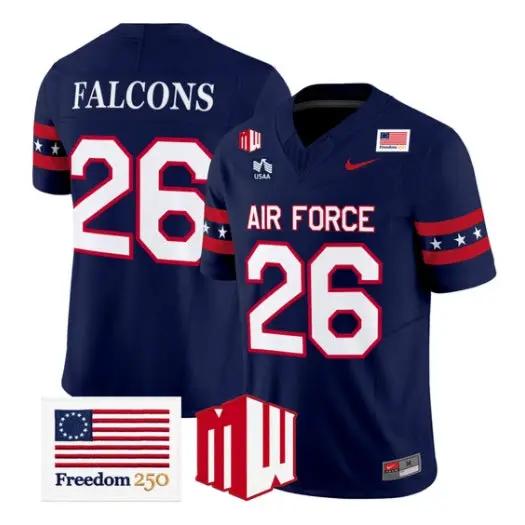
Custom options in this category include the 2026 Freedom 250 Limited, the 2026 Vapor Limited, the 2025 Honor F-16, plus White Away Game, Royal Blue Home Game, Black Alternate Game and Rivalry Legacy Series White versions. The lettering checks above apply to every one of them.
Skip the lettering with a ready-made jersey
Not everyone wants their own name on the back. If you would rather avoid proofreading altogether, a pre-lettered listing is the simpler route. A pick such as this Air Force Falcons #9 Vapor Limited White jersey arrives with its number already set, so there is nothing to type at checkout. The category also carries number-only and team-word listings, such as a Zoomie #719 listing, a STRATEGIC DETERRENCE #26 listing and a Falcons #26 listing in the 2026 Vapor Limited set, along with player-name versions like a Kyle Chen #3 listing or a Luke Fisher #0 listing.
What the stitched build means for mistakes
The listing describes stitched tackle twill letters and numbers with embroidered applique and graphics on a 100% recycled polyester body. That construction is the reason these checks matter so much: the lettering is sewn in, not pressed on. Getting it right the first time is easier for you and for the store.
A 60-second final checklist
- Spelling read backward and matched to a written source
- Character count reasonable, spaces and punctuation stated
- Number written in digits, no extra characters
- Second person has confirmed it
- Text pasted, not retyped, into the checkout message or email